 Steane Patterns
Part 1 · The code · Chapter 3 · 6 min read
Syndromes: finding an error without looking at the data
Measuring a qubit destroys what it holds. A syndrome is the way around that: ask a question about several qubits together, never about one, and the answer points at the error.
Key terms
Three questions about seven qubits
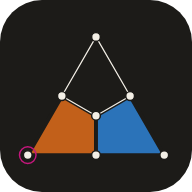
In Steane Patterns each logical qubit is a triangle. Its seven vertices are the data qubits. Its three faces are parity checks, one on the four vertices around each face. The Z checks (orange) ask about bit flips, the X checks (blue) about phase flips. This chapter follows bit flips; phase flips work the same way with the colours swapped.
The syndrome names the qubit
Write the three check results as three bits, face 1 first. A flip on qubit 4 gives 1 0 1. Read that as a binary number: 101 is 5, so the culprit is qubit 5 − 1 = 4, counting from 0. The same holds for all seven qubits. Each has its own pattern and no two share one.
In words: take the error pattern (one bit per qubit, 1 where a qubit is flipped), multiply by the check matrix and keep each result modulo 2. Column of is the number written in binary, which is why the syndrome can be read as a number.
Intuition
Three yes-or-no answers give outcomes: seven for “this qubit” and one for “nobody”.
Where it stops working
Flip two qubits and the pattern looks exactly like one flip on a third qubit, so the decoder repairs the wrong one. The three flips together form a logical operator, and that is a logical error. A distance-3 code corrects any single flip and nothing more. Larger codes and repeated rounds, the subject of the next chapters, are how that limit is pushed back.
Try it in the simulator
Choose Bit flip noise, set p to 0.02 and press Run. Every orange cell is a face whose check fired.
Open the simulator with this setupCheck yourself
Which faces light up for a flip on qubit 2?
Faces 2 and 3. The pattern 0 1 1 is 3 in binary, and 3 − 1 = 2.
Why can’t the decoder tell two flips from one?
Two columns of added together always give a third column, so the syndrome matches a single flip elsewhere.
Sources
- A. M. Steane (1996). Simple quantum error-correcting codes. Physical Review A 54, 4741. arxiv.org/abs/quant-ph/9605021
Supports: syndrome measurement for the seven-qubit code. - M. A. Nielsen, I. L. Chuang (2010). Quantum Computation and Quantum Information, 10th anniversary edition. Cambridge University Press. ISBN 978-1-107-00217-3. www.cambridge.org/9781107002173
Supports: error correction through syndromes (chapter 10 of the book). - D. Gottesman (1997). Stabilizer codes and quantum error correction. Ph.D. thesis, Caltech. arXiv:quant-ph/9705052. arxiv.org/abs/quant-ph/9705052
Supports: stabilizer codes and syndromes.