The qubits, 15 in total
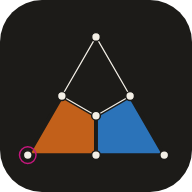
Each logical qubit is a triangle: its 7 vertices are data qubits (q0–q6 for logical A, q7–q13 for B), which hold the information. The 3 faces are not qubits: each is a parity check on the 4 vertices around it. One extra ancilla qubit (q14) measures those checks: it is entangled with a face, read out, reset, and reused, 12 times per round.
One round is one grid row
Every face is checked twice per round. The Z check (orange) catches bit flips (X errors), and the X check (blue) catches phase flips (Z errors). A cell is the bit the ancilla read: with no noise every check reads 0 and the grid stays dark. While a round plays, the triangle faces mirror it (orange fill = Z check fired, blue outline = X check fired).
The end of the shot
Only now are the data qubits measured (filled vertex = read 1). The faces then show the parities computed from those bits. The logical value is the parity of all 7 bits. A decoder looks at the whole pattern and guesses which qubits went wrong (pink rings: on vertices for data errors, on grid cells for faulty readouts). The verdict (corrected or logical error) is exact: the simulator tracks every injected error, so we know the truth.
Views
- Raw bits: what the ancilla measured.
- Detections: only checks that changed since the previous round, which is where new errors appeared. This is what decoders actually read.
- Heat map: how often each check fires over all shots.
Logical error rate
No decoding reads the raw parity. BP is plain belief propagation, which gets lost on the Steane code's short loops and often does not converge. Relay-BP (Müller et al., 2025) chains BP runs with randomized memory and keeps the best answer. Limit is the exact error rate of the best decoder that reads one error type at a time (maximum-likelihood, per Pauli type). Joint decoders that also use the other type can beat it under depolarizing noise, where one Y error links both types. (Not shown for SI1000, whose circuit-level noise the decoders only approximate). Relay-BP gets within a few percent of it (it picks the single most likely error, while the optimum adds up all equivalent ones). BP stays far above it.
Things to try
- Bit flip: only Z checks (orange) light up. Depolarizing: both colors.
- Depolarizing at p ≈ 0.03 with 256 shots: BP sits well above the limit, and Relay-BP sits close to it.
- SI1000 is realistic circuit noise from superconducting hardware: gates, readout and idling all fail.
- Music: block A plays low, block B high, Z checks triangle wave, X checks sine. A major chord means corrected, a dissonant one means a logical error.
 Steane Patterns